In the world of heavy - duty lifting and rigging, G80 lifting hooks are renowned for their strength, reliability, and safety. As a supplier of G80 Lifting Hooks, I've witnessed firsthand the importance of surface treatment in enhancing the performance and longevity of these essential tools. This blog post will delve into the various surface treatments of G80 lifting hooks, exploring their benefits, applications, and how they contribute to the overall quality of the product.
Understanding G80 Lifting Hooks
Before we discuss surface treatments, let's briefly understand what G80 lifting hooks are. G80 lifting hooks are made from high - strength alloy steel, which provides a minimum breaking strength that is 8 times the working load limit. They are commonly used in a wide range of industries, including construction, mining, manufacturing, and transportation. G80 hooks come in various types, such as Swivel Self - locking Hook, G80 Lifting Hook, and Eye Grab Hook, each designed for specific lifting applications.
The Importance of Surface Treatment
Surface treatment of G80 lifting hooks is not just about aesthetics; it plays a crucial role in protecting the hook from corrosion, wear, and other forms of damage. In harsh working environments, where hooks are exposed to moisture, chemicals, and abrasive materials, a proper surface treatment can significantly extend the hook's service life and ensure its safe operation.
Common Surface Treatments for G80 Lifting Hooks
Galvanizing
Galvanizing is one of the most popular surface treatments for G80 lifting hooks. It involves coating the hook with a layer of zinc, which acts as a sacrificial anode to protect the underlying steel from corrosion. There are two main types of galvanizing: hot - dip galvanizing and electro - galvanizing.
Hot - dip galvanizing is a process where the hook is immersed in a bath of molten zinc at a temperature of around 450°C. This results in a thick, durable zinc coating that provides excellent corrosion resistance. The zinc coating forms a metallurgical bond with the steel, which means it adheres well and is less likely to peel or flake off. Hot - dip galvanized G80 lifting hooks are suitable for outdoor applications, such as construction sites and shipyards, where they are exposed to rain, humidity, and saltwater.
Electro - galvanizing, on the other hand, is a process where zinc is deposited onto the hook's surface through an electrochemical reaction. This method produces a thinner zinc coating compared to hot - dip galvanizing, but it offers a smoother and more uniform finish. Electro - galvanized hooks are often used in indoor applications or environments with less severe corrosion conditions.
Powder Coating
Powder coating is another common surface treatment for G80 lifting hooks. It involves applying a dry powder paint to the hook's surface and then curing it in an oven at a high temperature. The powder particles melt and flow together to form a continuous, durable coating.
Powder coating offers several advantages. Firstly, it provides excellent corrosion resistance, similar to galvanizing. Secondly, it comes in a wide range of colors, allowing for customization according to the customer's preferences or industry standards. Additionally, powder - coated hooks have a smooth and attractive finish, which can enhance their appearance. Powder - coated G80 lifting hooks are commonly used in industries where aesthetics are important, such as in the manufacturing of high - end equipment or in decorative lifting applications.
Black Oxide Coating
Black oxide coating is a chemical conversion coating that forms a thin, black layer on the surface of the G80 lifting hook. This coating provides a moderate level of corrosion resistance and also has some anti - galling properties.
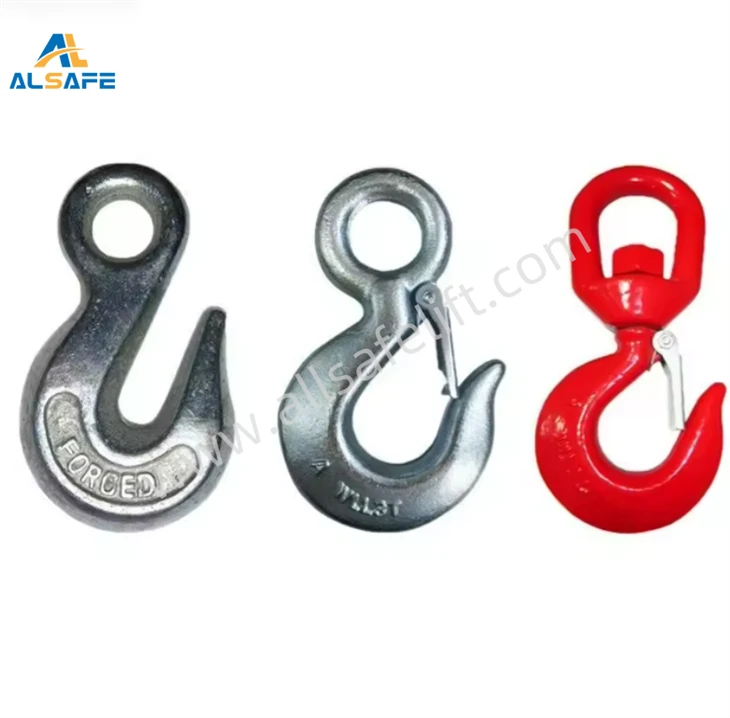
The black oxide coating process involves immersing the hook in a series of chemical baths that react with the steel surface to form the black oxide layer. One of the main advantages of black oxide coating is that it does not add significant thickness to the hook, which is important in applications where precise dimensions are required. Black - oxide - coated G80 lifting hooks are often used in machinery and equipment where a low - profile, corrosion - resistant finish is desired.
Factors Affecting Surface Treatment Selection
When choosing a surface treatment for G80 lifting hooks, several factors need to be considered.
Environmental Conditions
The environment in which the hook will be used is a crucial factor. If the hook will be exposed to harsh outdoor conditions, such as saltwater, high humidity, or extreme temperatures, hot - dip galvanizing is usually the best choice due to its superior corrosion resistance. For indoor applications or less corrosive environments, electro - galvanizing, powder coating, or black oxide coating may be sufficient.
Cost
Cost is also an important consideration. Hot - dip galvanizing is generally more expensive than electro - galvanizing or black oxide coating due to the higher cost of materials and the energy - intensive process. Powder coating can vary in cost depending on the type of powder used and the complexity of the coating process. Customers need to balance the cost of the surface treatment with the expected service life and performance requirements of the hook.
Aesthetic Requirements
In some industries, the appearance of the lifting hook is important. For example, in the production of high - end consumer goods or in architectural applications, a powder - coated hook with a custom color may be preferred. On the other hand, in more industrial settings, the focus may be more on functionality rather than aesthetics, and a more utilitarian surface treatment like galvanizing may be chosen.

Quality Assurance in Surface Treatment
As a G80 Lifting Hook supplier, we take quality assurance in surface treatment very seriously. We have strict quality control measures in place to ensure that each hook receives the proper surface treatment and meets the required standards.
Before the surface treatment process, the hooks are thoroughly cleaned to remove any dirt, grease, or rust. This ensures good adhesion of the coating. During the treatment process, we monitor key parameters such as temperature, time, and coating thickness to ensure consistency and quality. After the treatment, the hooks are inspected for any defects, such as uneven coating, peeling, or blistering. Only hooks that pass our rigorous quality checks are released for sale.

Conclusion
In conclusion, the surface treatment of G80 lifting hooks is an essential aspect of their manufacturing process. Whether it's galvanizing, powder coating, or black oxide coating, each treatment offers unique benefits in terms of corrosion resistance, wear protection, and aesthetics. By carefully selecting the appropriate surface treatment based on environmental conditions, cost, and aesthetic requirements, customers can ensure that their G80 lifting hooks perform reliably and safely over a long period of time.
If you are in the market for high - quality G80 lifting hooks, we invite you to contact us for more information and to discuss your specific requirements. Our team of experts is ready to assist you in choosing the right hook with the optimal surface treatment for your application.
References
- ASME B30.10 - Safety Standard for Hooks
- ASTM A153/A153M - Standard Specification for Zinc Coating (Hot - Dip) on Iron and Steel Hardware
- ISO 9001:2015 - Quality Management Systems Requirements