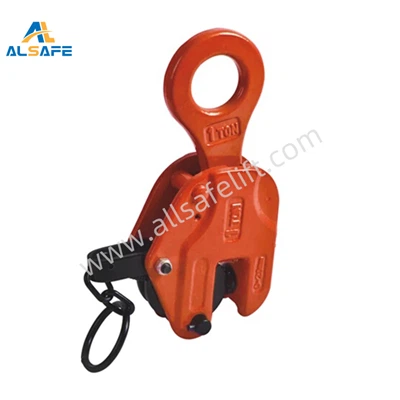
As a professional lifting clamp supplier, I often encounter customers who are unsure about the differences between single - jaw and double - jaw lifting clamps. In this blog, I'll delve into the characteristics, applications, and advantages of each type, helping you make an informed decision when choosing the right lifting clamp for your needs.
Structural Design
The most obvious difference between single - jaw and double - jaw lifting clamps lies in their structural design. A single - jaw lifting clamp, as the name suggests, has a single clamping jaw. This simple design allows it to grip objects from one side. It typically consists of a single jaw, a handle or lever for operation, and a mechanism to secure the load.
On the other hand, a double - jaw lifting clamp features two clamping jaws. These jaws can work in tandem to grip an object from both sides. The double - jaw design is more complex, usually including two jaws, a connecting mechanism, and an operating device. This structure provides a more balanced and stable grip on the load.
Working Principle
The working principle of a single - jaw lifting clamp is based on the force applied through the handle or lever. When the operator applies force, the single jaw moves towards the object to be lifted, creating friction and clamping force. This force is sufficient to hold the load during lifting operations. However, the single - sided clamping may cause the load to be slightly tilted or unstable, especially for larger or irregularly shaped objects.
In contrast, a double - jaw lifting clamp uses the coordinated movement of two jaws to grip the load. The two jaws move towards each other simultaneously, applying equal and opposite forces on the object. This balanced force distribution ensures that the load remains stable and centered during lifting. The double - jaw mechanism also allows for a more secure grip, reducing the risk of the load slipping.
Load Capacity
Load capacity is an important factor to consider when choosing a lifting clamp. Single - jaw lifting clamps generally have a lower load capacity compared to double - jaw lifting clamps. This is because the single - jaw design can only apply clamping force from one side, which limits the amount of weight it can safely hold. Single - jaw clamps are often suitable for lighter loads, such as small pipes, bars, or thin plates.
Double - jaw lifting clamps, with their balanced and dual - sided clamping force, can handle much heavier loads. They are commonly used in industrial applications where large and heavy objects need to be lifted, such as steel beams, large machinery components, and heavy plates. The double - jaw design distributes the load evenly between the two jaws, increasing the overall load - bearing capacity.
Applications
The application scenarios of single - jaw and double - jaw lifting clamps are also quite different. Single - jaw lifting clamps are commonly used in situations where access to the object is limited from one side. For example, in some narrow spaces or when lifting objects with one - sided support, a single - jaw clamp can be a practical choice. They are also suitable for quick and easy lifting of small items in workshops or on construction sites. You can also check out our Drum Lifter Hook for related lifting needs.
Double - jaw lifting clamps, due to their higher load capacity and stable clamping, are widely used in heavy - duty industries. In the construction industry, they are used to lift steel beams and columns during building construction. In the manufacturing industry, they are essential for handling large machinery parts and heavy metal sheets. Our Beam Clamp and Vertical Lifting Clamp are examples of double - jaw lifting clamps that are well - suited for these applications.
Advantages and Disadvantages
Single - jaw lifting clamps have several advantages. They are relatively simple in design, which makes them easy to operate and maintain. They are also more lightweight and portable, allowing for quick setup and use in various locations. However, their main disadvantage is the limited load capacity and the potential for load instability, especially for larger objects.
Double - jaw lifting clamps offer superior stability and higher load capacity. They can handle a wider range of loads and are more suitable for heavy - duty applications. The balanced clamping force ensures that the load remains secure during lifting. Nevertheless, the more complex design of double - jaw clamps may require more maintenance and can be more expensive compared to single - jaw clamps.
Choosing the Right Lifting Clamp
When choosing between a single - jaw and a double - jaw lifting clamp, you need to consider several factors. First, assess the weight and size of the load you need to lift. If it is a light and small object, a single - jaw clamp may be sufficient. For heavy and large loads, a double - jaw clamp is the better choice.


Second, consider the working environment. If the space is limited and you can only access the object from one side, a single - jaw clamp may be more practical. In open and large - scale industrial environments, a double - jaw clamp can provide better performance and safety.
Finally, think about your budget and long - term needs. If you only need to lift light loads occasionally, a single - jaw clamp may be a cost - effective option. However, if you are involved in heavy - duty lifting operations on a regular basis, investing in a high - quality double - jaw lifting clamp is worthwhile.
In conclusion, understanding the differences between single - jaw and double - jaw lifting clamps is crucial for making the right choice for your lifting tasks. As a lifting clamp supplier, we are committed to providing you with high - quality products and professional advice. If you have any questions about choosing the right lifting clamp or need more information about our products, please feel free to contact us for procurement and negotiation.
References
- Lifting Equipment Handbook, various industry standards and regulations on lifting clamps.
- Technical manuals of different lifting clamp manufacturers.